Built for SEO agencies, content agencies, and freelance operators handling recurring client delivery.
Use case / agencies
AI Content Workflow for Agencies
Turn client briefs into structured SEO production workflows that help your team create clearer, more useful content for the client's actual customer, with cleaner handoff, fewer rewrites, and faster delivery.
Turns client knowledge, audience pain, search intent, and conversion goals into one guided 8-step system before drafting starts.
Helps agencies show clients not just output volume, but a workflow that serves end readers and buyers better while keeping production more efficient.
Prompt box vs workflow
Why one-shot prompting breaks down when agencies must serve both clients and their customers
Agencies are not paid just to generate text. They are paid to understand the client's market, translate that into stronger content for the client's audience, and deliver it in a repeatable way. One-shot prompting hides too much of that work and too much of that risk.
One-shot prompt mode
What teams keep fighting when everything is one request
1
End-customer context disappears inside the request
Business goal, client positioning, audience pain, SERP logic, buying stage, and writing instructions all get compressed into one request, so nobody can verify whether the draft will actually help the client's customer before it appears.
2
Misalignment reaches the client late
When the first article misses the real reader question, proof angle, or conversion context, strategists, writers, account managers, and clients all end up reviewing the same mistake from different directions.
3
Client approval gets harder
If the workflow looks like one black box generation step, clients cannot easily see why the content will be better for their audience or why the team is spending time where it matters.
4
Every operator rebuilds the workflow
A new writer or editor inherits a draft, not the audience logic and production logic behind it, so recurring delivery becomes harder to stabilize across the account.
Guided 8-step system
What changes when the article is built as a system
1
Customer-facing intent is clarified before drafting
Angle framing, brand setup, intent review, evidence capture, outline logic, drafting, QA, and visual packaging are separated so the team can check whether the content will truly help the client's audience before the next step starts.
2
The team gets faster, cleaner handoff points
Every step leaves behind a clearer working asset, which makes it easier for strategists, writers, editors, and account leads to enter or leave the workflow without rebuilding context.
3
Clients can see why the content will serve their customers better
Because the structure is explicit, agencies can show why the article is stronger than a raw AI draft and why the delivery is built around real audience need rather than generic output.
4
Recurring delivery becomes faster and more repeatable
The same 8-step backbone can support monthly blog retainers, campaign pages, and higher-stakes commercial content without reinventing the workflow every cycle.
Why the 8-step system matters
Instead of asking one model call to guess strategy, audience, proof, and writing all at once, the workflow makes those decisions explicit so agencies can deliver content that is easier for clients to approve and more useful for the people they want to reach.
Actual example
Show clients a system built for better customer-facing content
Each run produces a structured workflow, publish-ready article output, SEO packaging, and stored assets your team can review, reuse, hand off, and use to explain why the content will serve the client's audience better.
Client-ready handoffExportable deliverablesVisible workflow valueRepeatable SOP
Example 01 / SEO delivery pack
Deliver the SEO package with the draft
HTML output is only one layer. The run also leaves behind title, meta, keyword, intent, slug, export options, and image-slot planning that agencies can reuse or hand over.
Inside this example
SEO pack includedTitle, meta, keyword, intent, slugExportable JSON / CSV / checklistLink and image slot planning
User-facing preview
Output preview
SEO Pack
Review metadata, exports, keywords, and publishing checks before handoff.
Copy JSONDownload JSONCopy CSVChecklist
Preview.md.htmlSEO PackVisuals 3
SEO Pack
Stored with the article run so operators can review, export, and hand off the same package.
SEO tab active
Title tag
Influencer Ecommerce Success: Why Products Don’t Sell
Meta description
Influencer ecommerce success starts with demand, systems, and fit.
Primary keyword
influencer ecommerce success
Target query
why influencer products do not sell
Search intent
informational
Slug
influencer-ecommerce-success-why-products-dont-sell
Secondary Keywords
creator commerceproduct launchbrand fitconversion pathdemand validation
Word count
1132
Target words
800
Reading time
6 min
Internal links
5
External links
3
Image slots
3
Quick checks
Title fits target query
Primary keyword is present without reading like a stuffed headline.
Meta description is usable
Short enough for SERP display and aligned with article promise.
Complete SEO pack
Full package
Complete SEO Pack
All metadata, structure, and QA details stay attached to the saved output.
Preview.md.htmlSEO PackVisuals 3
Title tag
Influencer Ecommerce Success: Why Products Don’t Sell
Meta description
Influencer ecommerce success starts with demand, systems, and fit.
Primary keyword
influencer ecommerce success
Target query
why influencer products do not sell
Search intent
informational
Slug
influencer-ecommerce-success-why-products-dont-sell
Canonical URL
blogworkflow.ai/resources/influencer-ecommerce-success
Locale / Country
en / global
Secondary Keywords
creator commerceproduct launchbrand fitconversion pathdemand validationwhy influencer stores fail
Word count
1132
Target words
800
Reading time
6 min
Internal links
5
External links
3
Image slots
3
Title length
57
Meta desc length
76
Format
HTML article
H2 Headings
Why followers alone do not create product demand
Where creator-led launches usually break down
How to structure an ecommerce offer before launch
What systems matter after the first wave of orders
Benchmark Checklist
Title fits target query
Primary keyword is present without reading like a stuffed headline.
Meta description is usable
Short enough for SERP display and aligned with article promise.
Internal linking is planned
Supporting pages and related resources are mapped before publish.
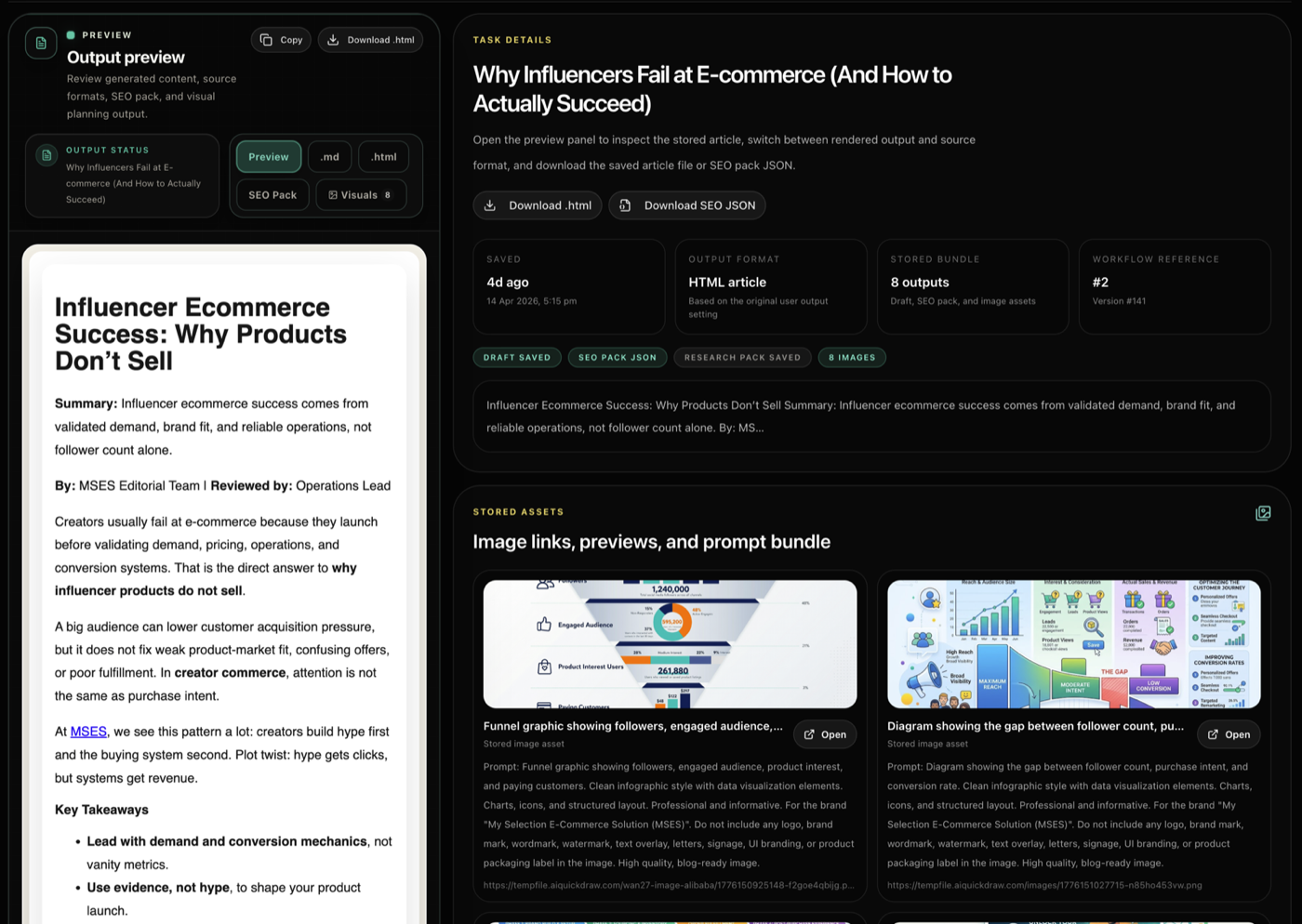
Example 02 / Stored output bundle
Give clients downloadable assets, not just body copy
Stored output history, downloadable HTML, SEO JSON, and image assets make delivery easier to explain and much easier to repeat across recurring client accounts.
Inside this example
Stored bundleDownloadable .html and SEO JSONDraft + SEO pack + image assetsSaved output history
Select an output area
Focus detail
Influencer Ecommerce Success: Why Products Don’t Sell
Summary: Influencer ecommerce success comes from validated demand, brand fit, and reliable operations, not follower count alone.
Creators usually fail at e-commerce because they launch before validating demand, pricing, operations, and conversion systems.
Key takeaways
- Lead with demand and conversion mechanics, not vanity metrics.
- Use evidence, not hype, to shape the product launch.
- Systems matter more than audience size when orders start coming in.
Selected output
Rendered article preview
The saved article stays readable before export, publish, or handoff.
8-step system
A client-ready 8-step system for content that serves the right audience
For agencies, the workflow is valuable because every stage helps the team validate audience need, search intent, proof, and publishing readiness before the article reaches the client. That is what makes recurring delivery more stable than one-shot prompting.
Frame · Steps 1-2
Lock the commercial angle, search job, brand voice, and audience promise before the workflow starts drafting.
Research · Steps 3-4
Profile intent, gaps, entities, evidence, and sources so the article is grounded before any long-form generation happens.
Build · Steps 5-6
Turn the research into a structured outline, then use AI to draft readable sections that still follow the brief.
Finish · Steps 7-8
Check claims, links, and publish packaging, then prepare visual support so the output is easier to release.
Frame / 01
The 8-step system turns one article into a reviewable production sequence
Topic and revenue angle
Define the business outcome, audience pain, and article promise before any writing starts.
Why this step exists
Commercial intent, primary topic selection, conversion relevance, and the reason this page should exist.
Deliverables leaving this step
Audience pain statementSearch angle and commercial objectivePrimary article promise
Steps 1-2: Lock the commercial angle, search job, brand voice, and audience promise before the workflow starts drafting.
01 / Agency delivery lens
How agencies teams use this step
Account leads and strategists can lock the client promise before writers improvise the angle from incomplete notes.
02 / Why not one-shot
What a single large prompt usually misses here
A single prompt often blends business goal, audience, and topic into one vague instruction, so the first draft sounds plausible but misses the real commercial job.
03 / AI role
What the model is doing at this stage
A reasoning model compresses the brief into a stable working objective so later steps inherit the same commercial direction.
04 / Outcome
What leaves this step and moves the workflow forward
The team inherits one client-defensible working brief instead of debating the article promise after drafting already started.
Step 1 / 8 · Frame
Topic and revenue angle
Define the business outcome, audience pain, and article promise before any writing starts.
Why this step exists
Commercial intent, primary topic selection, conversion relevance, and the reason this page should exist.
Audience pain statementSearch angle and commercial objectivePrimary article promise
01 / Agency delivery lens
How agencies teams use this step
Account leads and strategists can lock the client promise before writers improvise the angle from incomplete notes.
02 / Why not one-shot
What a single large prompt usually misses here
A single prompt often blends business goal, audience, and topic into one vague instruction, so the first draft sounds plausible but misses the real commercial job.
03 / AI role
What the model is doing at this stage
A reasoning model compresses the brief into a stable working objective so later steps inherit the same commercial direction.
04 / Outcome
What leaves this step and moves the workflow forward
The team inherits one client-defensible working brief instead of debating the article promise after drafting already started.
Pain points + what improves
Where the workflow reduces production drag
Agency teams usually do not lose margin because they cannot generate text. They lose margin because they have to decode client goals, reconstruct end-customer needs, and fix late-stage misalignment after the draft already exists.
blogworkflow.ai turns messy client input into a clearer operating sequence, so agencies can serve the client, the client's audience, and the internal team at the same time.
Pain points
Pain 01
Client briefs arrive fragmented
Core angles, audience pains, proof, internal links, conversion goals, and SEO expectations often arrive in separate messages or not at all.
Pain 02
The draft can miss the real reader job
When customer pain, search intent, or buying stage is unclear, the article can read fine while still failing the client's actual content goal.
Pain 03
Revision loops spread across the account
Once the first version misses angle or proof, account managers, writers, editors, and clients all end up spending time fixing the same misalignment.
Pain 04
Handoff and proof live in too many places
Research, outline logic, QA, and packaging notes often live in separate tools, making the workflow slower to run and harder to explain.
What improves
Improve 01
Align client goals with end-reader intent
Lock the brief, SERP direction, proof inputs, outline logic, and customer-facing angle before generation starts.
Improve 02
Reduce late-stage rewrites and approvals
A stronger structure up front means fewer corrections around audience fit, evidence, metadata, and section order after the client already sees the piece.
Improve 03
Create deliverables clients can publish faster
The workflow can output the article together with SEO notes, QA framing, and visual direction instead of handing over raw copy that still needs reconstruction.
Improve 04
Reuse one efficient system across recurring work
The same operating logic can support monthly blog production, campaign-led content, and higher-stakes commercial pages without rebuilding the workflow from zero.
Why it matters
Help agencies serve clients better without slowing down
A structured workflow creates visible value at each stage. That matters when agencies need cleaner internal coordination, stronger audience alignment, and a more defensible delivery story for clients.
Turn messy client context into a clearer workflow before drafting starts.
Reduce revision pressure caused by weak audience fit, weak outline logic, or missing proof.
Make it easier to show clients how the content will serve their customers.
Run recurring client production as one more efficient and repeatable SOP.
Magnet
Client-Ready SEO Content Workflow SOP
Request the agency SOP preview by email while the full downloadable version is being packaged.
We can send the preview now and follow up when the full SOP download is ready.
FAQ
Questions this use case page should answer.
This page is meant to stand on its own as a search and conversion page, so the FAQ focuses on fit, workflow expectations, and adoption questions for this audience.
Is this only for large agencies?+
No. It fits freelance operators, boutique agencies, and larger SEO or content teams that need a cleaner way to move from brief to delivery.
Will this replace writers or strategists?+
No. The workflow is meant to make writers and strategists more consistent by organizing brief, research, audience logic, outline, QA, and packaging decisions before and after generation.
Can agencies use this for recurring monthly article delivery?+
Yes. That is one of the strongest fits. A repeatable workflow is most valuable when the same team needs to deliver publish-ready content across multiple client cycles.
What makes this better than a generic AI writing app for agencies?+
Generic AI apps usually optimize for generation speed. blogworkflow.ai is designed around structured intake, clearer handoff, audience alignment, QA, and client-facing deliverables.
Can the workflow support client review and approval?+
Yes. The structure makes it easier to expose the logic behind the article before the final draft goes out, which helps internal and client-side review.
Next step
Start with one client brief, then build a faster client-delivery system.
Run a free session to validate the workflow, then use the same structure for recurring delivery, cleaner handoff, more useful customer-facing content, and less rework across the account.